
Ask the average Joe the first thing they know about scuba diving in Jordan and you will most likely get a blank look. Most people have heard of Petra, the iconic ancient city, carved into massive red cliffs, but scuba diving in Jordan?
Photographs by Nicolas Remy
If you ask a seasoned scuba diver, you might hear about some great wreck diving in Jordan, which keeps getting better as tanks, helicopters, and a massive aircraft were purposely sunk there. I had a chance to dive these wrecks, as I got invited to enter the first Aqaba Underwater Photography Competition.
Together with my model and lighting assistant Matt Waters, we also had time for some sight-seeing, which I will also cover in this article.
Getting to Jordan
The Kingdom of Jordan is located in the heart of the Middle East and is mostly land-locked, save for 27km of coastline around the city of Aqaba, where the diving takes place.
Aqaba is tucked in the north-eastern tip of the Red Sea, in between neighbouring Eilat (Israel) and Saudi Arabia, and facing the Sinai Peninsula (Egypt). You can fly direct to Aqaba or fly to Amman, and transfer by private car (120 JOD) or VIP bus (20 JOD) in about four hours.
There are several good hotels in Aqaba and many dive centres. We chose Deep Blue Dive Centre because of their interest for underwater photography, efforts to minimize environmental impact and their comfortable boats. We were treated with a warm, Jordanian welcome, five-star service and had lots of fun onboard.
Did you know?
The Underwater Military Museum is an amazing collection of old military equipment with tanks, an ambulance, an army crane, a troop carrier, an anti-aircraft gun and two helicopters. All the pieces are arranged in tactical war formation.
Diving logistics
Every morning, a mini-bus picked us up at our hotel downtown and drove us to the Tala Bay marina, where Deep Blue Dive
Centre is located. We would then embark on one of their boats for a double-tank dive, with a tasty lunch served in between, and refreshments after the second dive.

Most days we were on Deep Blue 2, a 23.9-metre-long motor yacht which had the amenities and comfort of a full-blown liveaboard, even though we were using it just for daytrips!
Upon return to the marina, we would leave our gear onboard, and the Deep Blue staff took care of cleaning and drying our wetsuits and putting everything together for the next day, so that we could just hop back into the bus and return to enjoy Aqaba city. It’s possible to do a third dive, and night dives are on offer too.
Wrecks – What Diving In Jordan Is All About
Aqaba is nowadays one of the world’s top wreck diving destinations, and this has a lot to do with the Jordanian Royal Family’s keen interest in scuba diving. This all started in 1985, when the late King Abullah II ordered the sinking of the Cedar Pride ship, followed by an anti-aircraft tank (M42 Duster) in 1999.
A tank sitting on sand is an unusual sight to say the least, and photos of that particular wreck have been widely published. Due to the pandemic, it is perhaps less known that an extra 20 wrecks that got scuttled in 2019, which I will cover below.
Cedar Pride
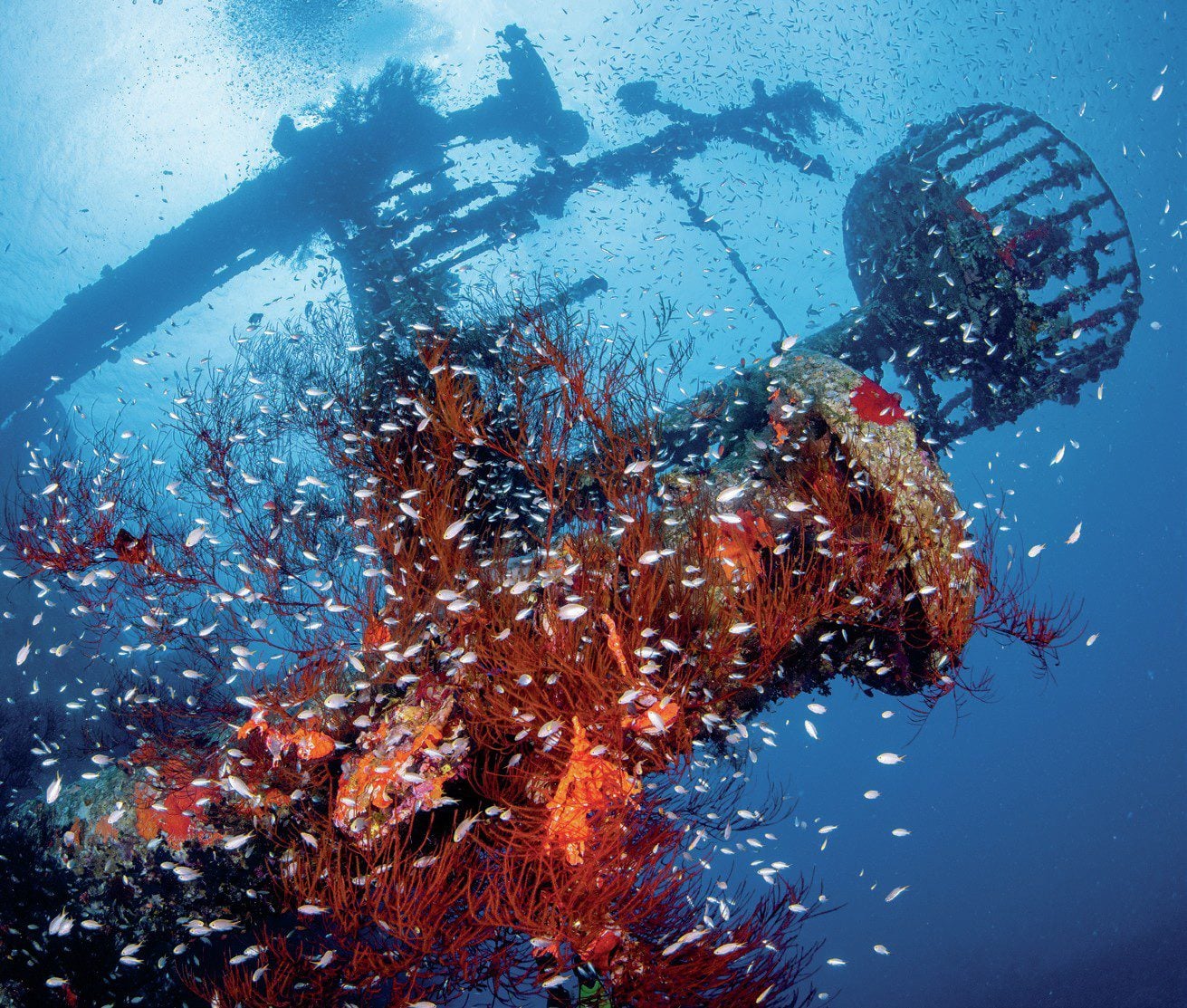
The 74-metre-long Cedar Pride shipwreck is Aqaba’s first purposely sunk wreck. Having spent 38 years in the Red Sea, it features hard and soft corals plus interesting marine life – lionfish, clownfish, turtle, anthias and giant frogfish are some of the regulars.
The wreck sits between 27m and 9m depth, and I found safety-stop depth was perfect to take a good view (and scenic photographs) of the ship, courtesy of the 20-25 metre visibility.
Given the sheer size of the boat, it is worth several visits to cover the various points of interest, and I recommend alternating between morning and afternoon dives, for a different atmosphere.
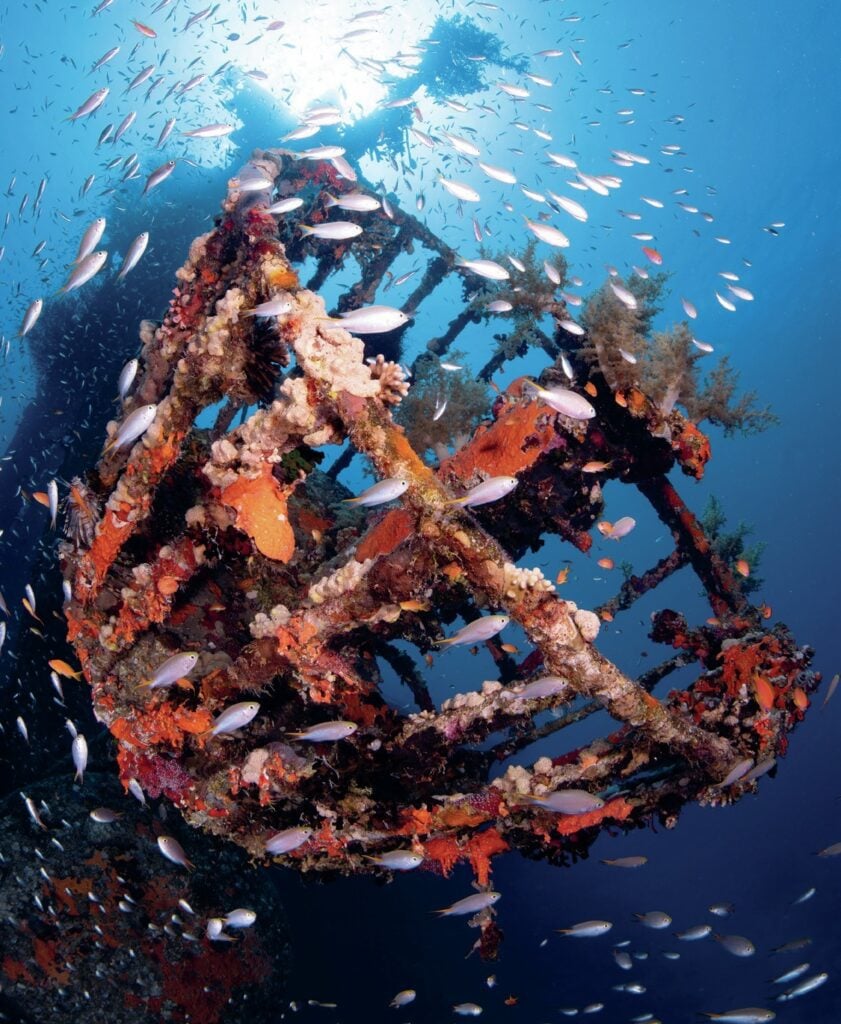
My favourite spot is the crow’s nest at 15m depth, which nicely stands out from the blue water, while being covered in colourful corals and fish life – agreat photo opportunity.
Another good photo-spot is the stern (17m deep), whose handrails are covered in red corals. If you back-off a little from the stern, towards deeper water, you’ll find a small pinnacle inhabited by anemonefish – another good photo to take, with the wreck visible in the background.
It’s also possible to explore the engine room and cabins inside the wreck, for divers suitably qualified.
Hercules C-130 and ‘the Tank’
Aqaba’s first plane wreck is the Hercules C-130, a large military troop carrier which was sunk in 2017 near the iconic M42 Duster tank. The plane is quite shallow, with the cockpit sitting in about 13m of water, while the massive tail is in 17m depth.

Unfortunately, in 2020 a severe storm roared through the gulf and cut the C-130 in two, so you will find the tail and the cockpit are now separated.

Both make for interesting photos, and you’ll find a skeleton tastefully installed on the pilot’s seat, sharing the cockpit with a school of glassfish.

You will encounter a small coral garden as you ascend towards the beach, and at 6m depth you can spend your safety stop exploring the famous M42 tank, which has been sitting there for 24 years.

Diving The Tristar In Jordan
A second plane wreck was scuttled just before Covid-19, but this one was a commercial aircraft – a Lockheed L-1011 Tristar. With a 50 metre length and 400 passenger capacity, the TriStar is a wide-body airliner, in the same league as your modern Airbus A350 or Boeing 787.
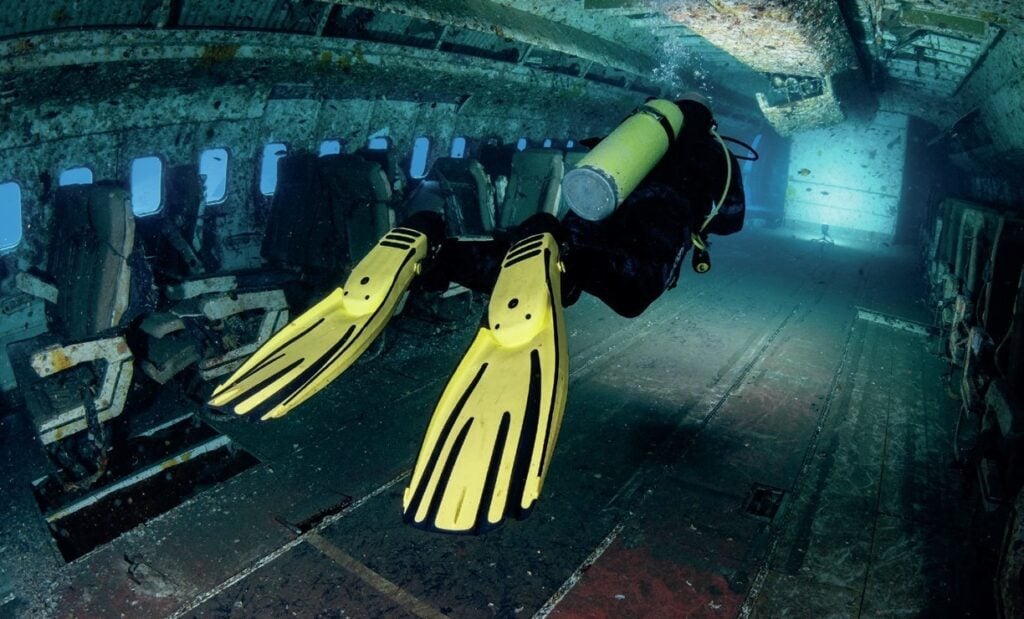
For anyone who likes air travel, this aircraft will be a joy to dive – the two rows of three seats have been left inside the two cabins, along with carry-on baggage compartments, roof-mounted video projectors and, as the cherry on the cake, the cockpit holds all navigation instruments.
The cockpit sits on a 17m sandy bottom, with the rest of the plane sloping down to a maximum of 30m, which is the bottom of the tail. The wreck is easy to penetrate and the depth inside the passenger cabins goes from 16m to 26m.
Unlike modern twin-jets airliners, the TriStar has a third engine mounted on the tail, which you can enter from the bottom of the deepest cabin and exit via the intake, bringing you above the fuselage.
This is one of the many photo opportunities on this wreck, which photographers will enjoy visiting multiple times. If it is marine life you’re after, check below the wings were soft corals have grown rapidly, and between the seats for the occasional porcupinefish!
Deep Blue Dive Centre
Deep Blue Dive Centre is located on South Beach in beautiful Tala Bay Resort in Aqaba, Jordan. Aqaba is home to some great dive sites for wreck and reef lovers. Underwater photographers and videographers will enjoy the opportunity to shoot wrecks, macro life, and beautiful reefs on one of our 20+ dive sites. Deep Blue Dive Centre is a PADI IDC Centre, PADI Eco Centre and a Certified Green Fins Silver member.
www.deepbluedivecenter.com
The Military Museum
After our first dive in the Underwater Military Museum, I remember telling my buddy Matt: “This place is the ultimate playground for grown-ups!” Indeed, no less than 19 wrecks got scuttled off the same beach, to create the world’s first underwater military museum.
Imagine swimming over Cobra helicopters, cannons, jeeps, and various armoured vehicles, including troop carriers, M42 Duster tanks, an ambulance and FV701 Ferrets!
As divers, we tend to swim about a metre over the bottom and this is best to spot the marine life which now inhabits those wrecks. However, I recommend you also ascend by a few metres, to appreciate the museum from above.
It feels like flying when you’re hovering above these military vehicles, which you will notice are laid-out in battle formation. Most of the wrecks 15m to 20m deep, with one of the two choppers being the deepest point at 27m, and two jeeps are parked at safety-stop depth.
Obviously the 19 wrecks are the main attraction, but I wish I could come back with a macro lens – my buddy noticed two robust ghost pipefish next to a helicopter, and a large concentration of garden eels lives just above the M42 tanks.
It is possible to see all of the wrecks in one dive, if you’re good on air and don’t mind swimming long distances. As a photographer though, I much preferred dedicating my dives to specific parts of the site.
Coral dives
Aqaba also has several coral reefs to offer, plus some very lively jetties. We had one dive under Bernice Jetty, and despite the shallow 4m depth, it was an underwater photographer’s paradise – lionfish were patrolling the pylons, covered with colourful soft corals, while glassfish were diffusing the sunrays just below the surface. A treat for the eye and the lens alike!

Sight-seeing
Petra is only a two-hour drive away from Aqaba, making it an easy day-tour to complement the diving, and I can’t recommend it enough. It is one thing to see the ancient city in photos, but an awe-inspiring experience to see the ancient building unfold before you, as you walk in between red sand-stone cliffs.
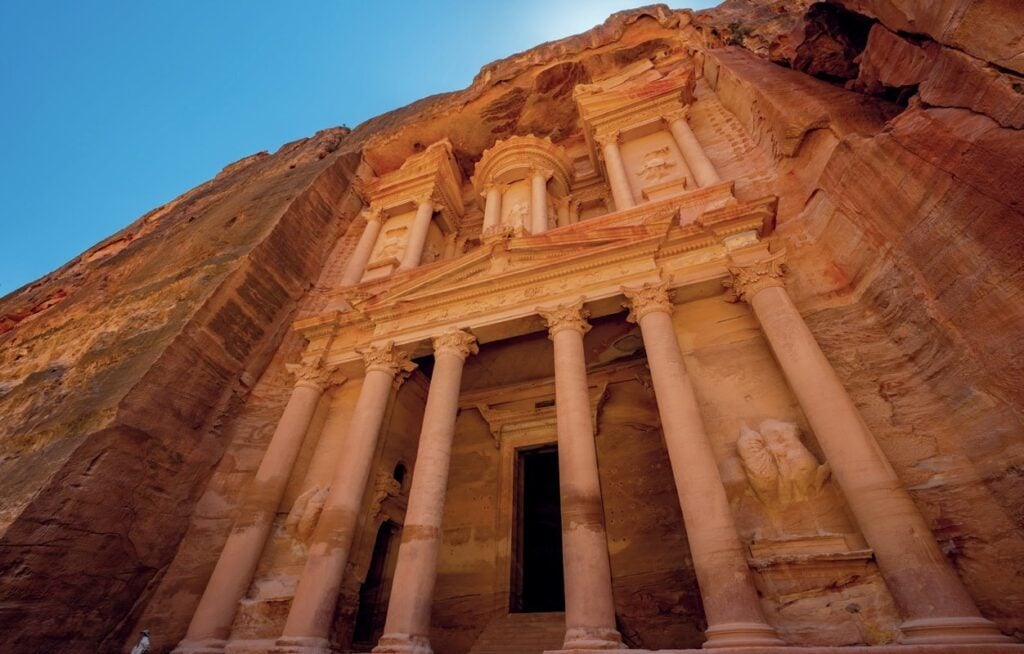
The Wadi Rum desert – astunning, desolate landscape utilized in many Hollywood movies, including some of the Star Wars films, The Martian and Red Planet – is close-by too and both places can be visited as a daytrip from Aqaba.
The Dead Sea is another interesting sight but much further away, so it is easier to visit from Amman.
Frequently Asked Questions
Is the scuba diving in Jordan any good?
Yes, Jordan offers excellent diving in Aqaba, including coral reefs, wrecks like the Cedar Pride, and the world’s first Underwater Military Museum.
What wrecks can you dive in Aqaba, Jordan?
Aqaba is home to wrecks like the Cedar Pride, Hercules C-130, Lockheed Tristar, M42 Duster tanks, helicopters, and many more military vehicles.
How deep are the wreck dives in Aqaba?
Most wrecks lie between 10–30 metres, making them accessible to recreational divers. Some highlights include the Tristar at 30m and helicopters at 27m.
Can I combine scuba diving in Jordan with sightseeing?
Yes, Petra, Wadi Rum, and the Dead Sea are easily accessible from Aqaba, making Jordan a unique blend of diving and cultural exploration.
In Conclusion
Scuba diving in Jordan is very much worth the effort and the wrecks of Aqaba offer a fun diving experience and a great playground for underwater image makers. There is a good diversity of small marine life too and I’ll bring a macro lens for my next visit.
Aqaba itself is a lively city where it felt safe to walk after sunset – we much enjoyed the local eateries and occasional roof-top bar. All-in-one, Jordan offers a great combination of unique diving and bucket-list sites like Petra and Wadi Rum.
Nicolas and Lena Remy
For more images from Nicolas and Lena Remy, visit their website or follow them on Instagram and Facebook @nicolaslenaremy. Keen to learn underwater photography, check their courses:
This article was originally published in Scuba Diver ANZ #63
Subscribe today with promo code DIVE1 — enjoy 12 months for just £1!
